
Why your Brooklyn sewer keeps backing up: five causes a camera can separate
If the same Brooklyn sewer keeps backing up, the first clearing restored flow but did not settle the cause. A camera can separate an isolated obstruction from wall buildup, root intrusion, a grade or joint problem, and structural failure. Those conditions do not deserve the same tool—or the same quote.
The rule is simple: do not turn “it backed up again” into “you need a new line.” Get the line clear enough to inspect, then match the response to what is visible.
What a camera can actually do
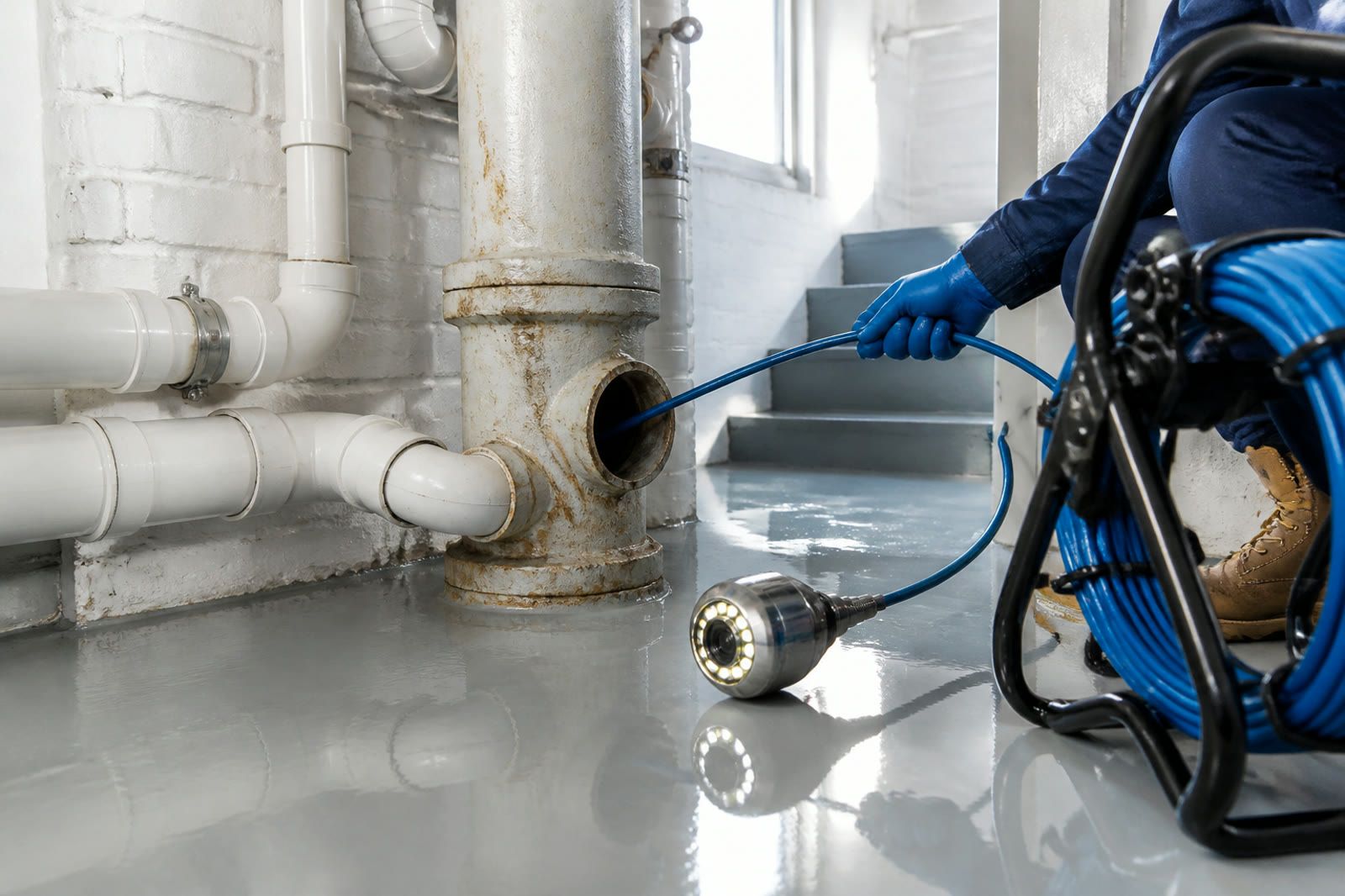
A sewer camera travels through an accessible cleanout or other appropriate entry. In a clear, traversable line, it can show visible material, joints, deposits, roots, cracks, offsets, deformation, standing water, collapse, and changes from cast iron to clay or PVC.
NASSCO’s assessment guidance calls detailed CCTV one of the most important tools for evaluating structural, maintenance, and physical pipe conditions. NASSCO also stresses the basics: appropriate camera size, lighting, centering, focus, and a clean enough line to see the wall.
That last part matters. A camera pushed into opaque sewage or a solid root ball cannot inspect the pipe beyond it. Sometimes the honest order is clear first, camera second, and return for a full condition pass if the first view was blocked.
Cause 1: an isolated obstruction
Paper, wipes, a foreign object, or another localized mass can block an otherwise serviceable line. On camera, the useful evidence is not only the object; it is the pipe around it. If the wall and joints are visible and sound after removal, an isolated clog may be exactly that.
A cable machine can use different heads to break, retrieve, or cut material. RIDGID’s official tool guide lists separate cutters for grease, roots, scale-like deposits, rags, and exploratory work. That is why “we snaked it” does not say what tool met what blockage.
For a one-time, isolated obstruction, drain cleaning may be the complete answer. Recurrence at the same location is a reason to look harder at the wall, grade, and joint.
Cause 2: grease, sludge, or scale narrowing the line
Wall buildup behaves differently from one object. Grease and sludge can coat the circumference. Old cast iron can develop a rough, scaled interior that reduces the open channel and catches waste. A cable may restore a route through the center while substantial material remains.
A hydro jet uses high-pressure water and a selected nozzle to break up and flush buildup. Manufacturer examples range from 3,000 PSI to 4,000 PSI, but pressure alone does not choose the service. Flow, nozzle, pipe diameter, access, and condition matter.
The after-cleaning camera should show whether the wall is materially clearer and whether buildup was hiding a crack, corrosion hole, or failed connection.
Cause 3: tree roots entering through a defect
Roots are an obstruction and evidence of an opening. They may enter an old clay joint, a crack, a failed cast-iron connection, or another leak path. Clearing the roots restores flow; it does not make that entry point watertight.
The USDA Forest Service’s research review found older clay and concrete sewers without rubber-gasketed joints especially prone to intrusion and describes mechanical cutting as temporary when the opening remains. On Brooklyn blocks lined with London planes, sycamores, maples, and oaks, the tree species is not the diagnosis. The camera needs to show where roots cross the pipe wall.
One root-filled joint may support monitoring, maintenance, or a targeted repair. Roots at repeated joints may support a larger scope. See the full root-intrusion decision path.
Cause 4: offset joints, bad alignment, or a belly
A pipe can remain open yet drain poorly because sections are offset or the route holds standing water. Debris settles in the low area, the usable cross-section shrinks, and the next blockage forms in the same place.
The camera can show an abrupt joint offset and persistent water that obscures part of the image. It cannot always prove the exact outside geometry from one pass. Distance measurements, locating, depth information, and sometimes exposure are needed to design a correction.
Cleaning may remove the accumulated debris without correcting the profile. If the low point fills again, the repeat backup is not proof that the cleaning “failed”; it may be evidence that grade or alignment remains the cause.
Cause 5: a cracked, corroded, deformed, or collapsed pipe
Structural failure changes the conversation from cleaning to repair. The EPA’s sewer-rehabilitation guidance lists different typical defects by material: clay is associated with cracks, breaks, roots, and joint leakage; cast iron with corrosion, breaks, grease, and joint failure; PVC with deflection, alignment, and connection problems.
One isolated defect does not automatically require the whole line. Repeated fractures, broad corrosion loss, multiple failed joints, or collapse can justify a wider scope. Our sewer-line repair page starts with that pattern, and the repair-versus-replacement guide separates the two decisions.
Where heavy rain and DEP fit
Brooklyn’s combined sewers add a sixth context: wet-weather surcharge. About 60% of NYC has a combined system carrying wastewater and stormwater, according to NYC DEP. A private lateral can appear serviceable on camera and still be exposed to reverse flow when the public system rises. A partially blocked private line can also perform worse during the same storm.
Report raw sewage backups to 311. DEP says it investigates the public side and starts City repair when it finds a City-system problem. Camera evidence addresses the private line; timing, neighbor reports, and DEP’s investigation address the broader event. Our storm-backup guide puts those pieces together.
Questions to ask after the camera pass
- Could the camera see the full accessible run?
- What exact cause is visible, and at what measured distance?
- Is the condition isolated or repeated?
- What did cleaning change—and what did it leave?
- Does the proposed service restore flow, correct the defect, or both?
- What remains unknown because of access, water, or an impassable section?
We won’t quote what we can’t show you. A diagnosis should name both the evidence and its limits.
Frequently asked questions
Why does my main sewer back up after it was snaked?
The cable may have restored flow without removing all wall buildup, roots, or the structural cause. It may also be a new isolated obstruction. Camera the cleared line before repeating a service by habit.
Can a camera see through standing water?
It can travel through some water, but murky or deep standing water hides the lower pipe wall and can limit the diagnosis. The report should state what was not visible.
Does every recurring backup mean broken pipe?
No. Recurring grease, roots, an offset, bad grade, or wet-weather surcharge can all cause repeats. Structural failure is one category, not the automatic answer.
Should I call 311 or a plumber during a storm backup?
Report raw sewage to 311 and call a sewer professional when the private line or immediate building condition needs attention. The DEP-or-plumber guide explains why both calls may be appropriate.
Ready to stop repeating the same clearing?
Brooklyn Sewer Solutions is owner-operated and available 24/7. We inspect the accessible line, show what is visible, and match the next step to the cause.