
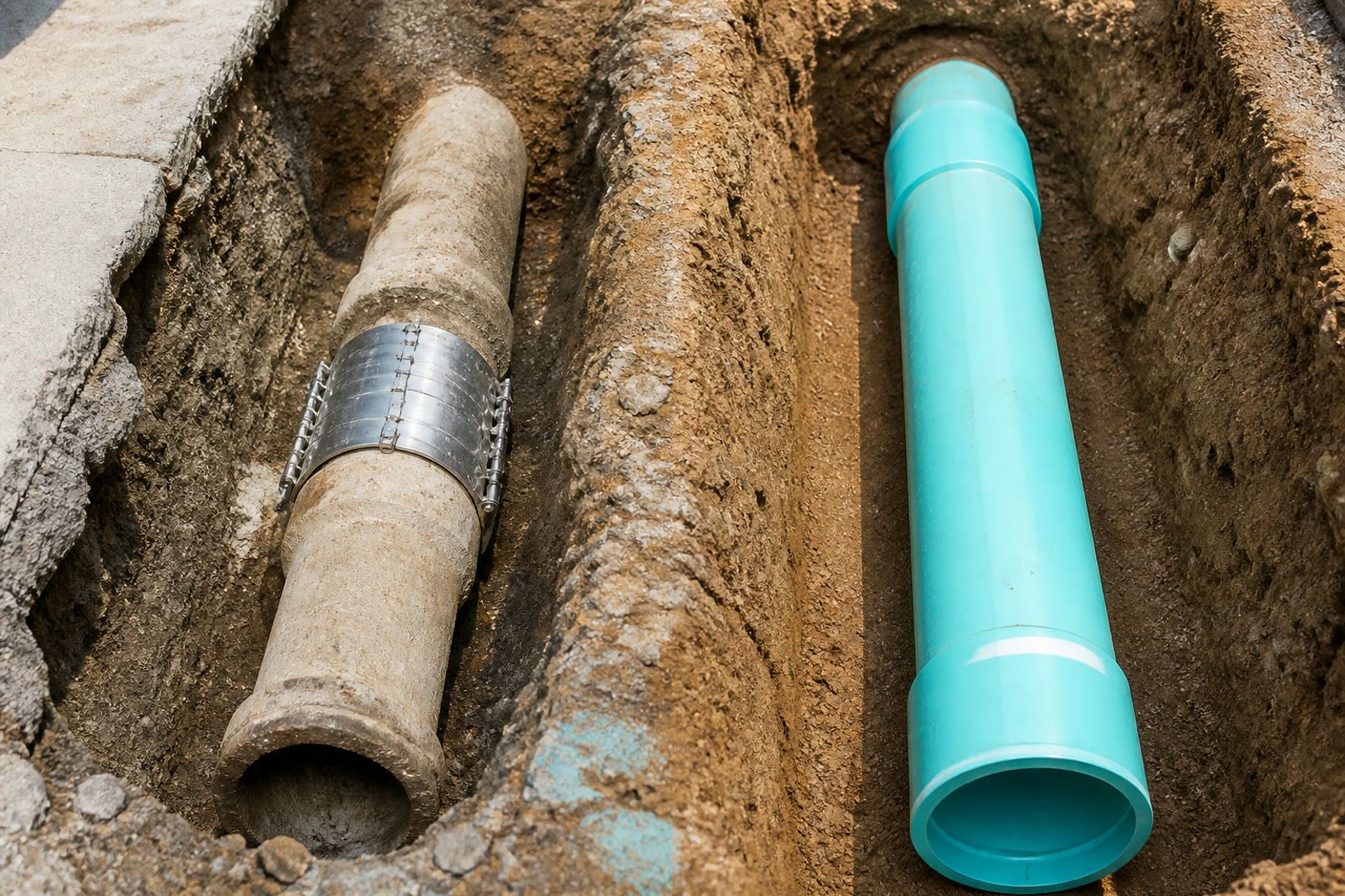
Sewer line repair vs. replacement in Brooklyn: how to decide
Repair makes sense when the evidence shows a limited defect and the surrounding pipe remains serviceable. Replacement becomes reasonable when structural failure is repeated, continuous, or impossible to correct reliably as a small section. The decision is about extent, not fear, building age, or how dramatic the backup looked.
For a Brooklyn brownstone, the route may pass under a cellar slab, areaway, stoop, sidewalk, and street. That makes a wrong scope expensive. Camera first, location second, quote third.
Start by defining the words
A repair corrects a specific defect or limited section. That might mean exposing and replacing a short broken segment or using an appropriate localized rehabilitation method.
A replacement renews the whole failed run or a substantial continuous length because the host pipe can no longer be trusted as a series of isolated repairs.
Cleaning is neither. Snaking or hydro jetting can remove an obstruction and restore flow, but it does not repair a crack, separated joint, bad grade, corrosion hole, or collapse. If roots entered through one clay joint, clearing the roots addresses the blockage; sealing or replacing the failed area addresses the opening.
The evidence sequence
1. Get an inspectable line
A camera cannot diagnose pipe hidden behind sewage, scale, roots, or a complete obstruction. The first service may need to restore flow or clean enough wall for a proper view. That is diagnostic preparation, not proof that the structure is sound.
2. Inspect and record the visible conditions
A camera inspection should identify what can actually be seen: material, joints, roots, deposits, cracks, offsets, holes, deformation, standing water, collapse, and transitions. NASSCO calls detailed internal CCTV the most important tool for assessing a sewer’s structural, maintenance, and dimensional condition (NASSCO assessment guidance).
3. Measure and locate the defect
Distance from the access point helps place the observation along the route. Compatible locating equipment may help mark the camera head from the surface. The scope should say where the defect is believed to be and what assumptions remain about depth or alignment.
4. Count the pattern, not just the worst frame
One failed clay joint surrounded by sound sections is a repair question. Roots at six joints, repeated offsets, broad corrosion loss, or several broken sections may support a larger scope. A camera paused on the ugliest frame can make one defect look like a whole-line verdict. Ask to see the run before and after it.
When a targeted repair may make sense
A limited repair is easier to defend when:
- one crack, break, offset, or failed joint is clearly located;
- pipe on both sides appears structurally serviceable;
- the line maintains a usable grade outside the defect;
- the repair can reconnect to sound material;
- access and restoration do not make a short repair impractical; and
- there is no repeated pattern suggesting the next section is already failing.
Material alone does not cancel this option. An old clay lateral can have one displaced joint. Cast iron can have one failed transition. PVC can have one poor connection or deformed section. The EPA’s rehabilitation guidance describes spot repairs for isolated, severe problems in short portions of a lateral.
When replacement may be the better decision
Replacement deserves consideration when:
- structural defects repeat along a substantial part of the run;
- the pipe is collapsed, broadly fractured, or badly deformed;
- extensive corrosion or wall loss affects continuity;
- multiple joints are separated, offset, leaking, or root-filled;
- grade or alignment problems create persistent standing water across the run;
- previous spot repairs leave too little reliable host pipe between them; or
- a rehabilitation method cannot work with the geometry or structural condition.
EPA guidance separates materials by typical defect patterns: vitrified clay often presents roots, cracks, breaks, and joint leakage; cast iron presents corrosion, breaks, grease, and joint failure; PVC presents deflection, alignment, and connection issues (EPA white paper). Those patterns help interpret footage. They do not replace it.
What does not prove you need replacement
One backup
A severe backup can come from a removable obstruction. The volume of sewage in the basement does not measure the length of damaged pipe.
Roots by themselves
Roots prove an opening and an obstruction. They do not prove every section is unsound. The entry may be one joint or one crack; the camera needs to show the surrounding pipe.
“The house is old”
Pre-war Brooklyn housing can contain cast iron, clay, and later repair materials. Age raises sensible questions but does not map the underground history. Our brownstone-backup guide gives the context without turning the deed date into a diagnosis.
A camera that could not pass
An impassable point is important, but the unseen line beyond it remains unseen. The proposal should state that limitation and explain how it affects the scope.
Put repair proposals on the same page
When comparing quotes, ask each contractor to identify:
- the defect, material, and measured location;
- the amount of pipe included;
- what visible evidence supports repair or replacement;
- what remains unknown about depth, utilities, or access;
- who handles permits, inspection, and restoration;
- what could change the scope after exposure; and
- whether cleaning, temporary flow restoration, and final testing are included.
Our sewer-line repair page explains the camera-first approach, and the pricing page explains why access, length, location, and method affect a quote. We won’t turn an unseen route into a fixed promise.
NYC responsibility and permitting still apply
NYC assigns the owner responsibility for the service line from the building to the City main. For repair or relay of a sewer house connection, DEP requires a Licensed Master Plumber to file the permit; DOB outlines the related application and inspection process.
Confirm the plumber of record and permit route before work begins. Brooklyn Sewer Solutions does not publish an unverified license number in this article.
Frequently asked questions
Can one broken sewer section be repaired?
Often, yes, when it is isolated, locatable, accessible, and bordered by serviceable pipe. The method depends on the defect, material, geometry, and location.
Do recurring roots mean I need a whole new line?
Not automatically. Recurring roots mean the entry defect remains. One failed joint may support a targeted repair; roots at repeated defects may support broader rehabilitation or replacement.
Should I get a second camera opinion before replacement?
For a major scope, it is reasonable to get the footage, measured observations, and another qualified review. Ask whether the full line was visible and whether cleaning was needed first.
Is trenchless always better than digging?
No. Trenchless methods reduce surface disruption in the right conditions, but geometry, collapse, utilities, access, and grade can rule them out. That is the next decision—not this one.
If replacement is justified, choose the method next
Do not collapse two decisions into one sales pitch. First establish why the line needs replacement. Then compare trenchless versus excavation for a Brooklyn brownstone using the route, utilities, access, and restoration requirements.
For a camera-based scope, call (718) 517-0800 or request an inspection.