
Trenchless vs. excavation sewer repair for Brooklyn brownstones
Once the evidence supports replacing a failed sewer run, the next question is how: use a trenchless replacement method such as pipe bursting, or excavate and replace the pipe directly. Trenchless can reduce surface disruption. Excavation gives direct access and control. Neither is automatically better.
This article assumes the replacement decision has already been made. If that is still in dispute, start with repair versus replacement. Do not choose a method before you know the scope.
First, clear up the terminology
“Trenchless” is a family of methods, not one product and not literally no digging. Pipe bursting, cured-in-place pipe (CIPP), sliplining, and other techniques do different jobs.
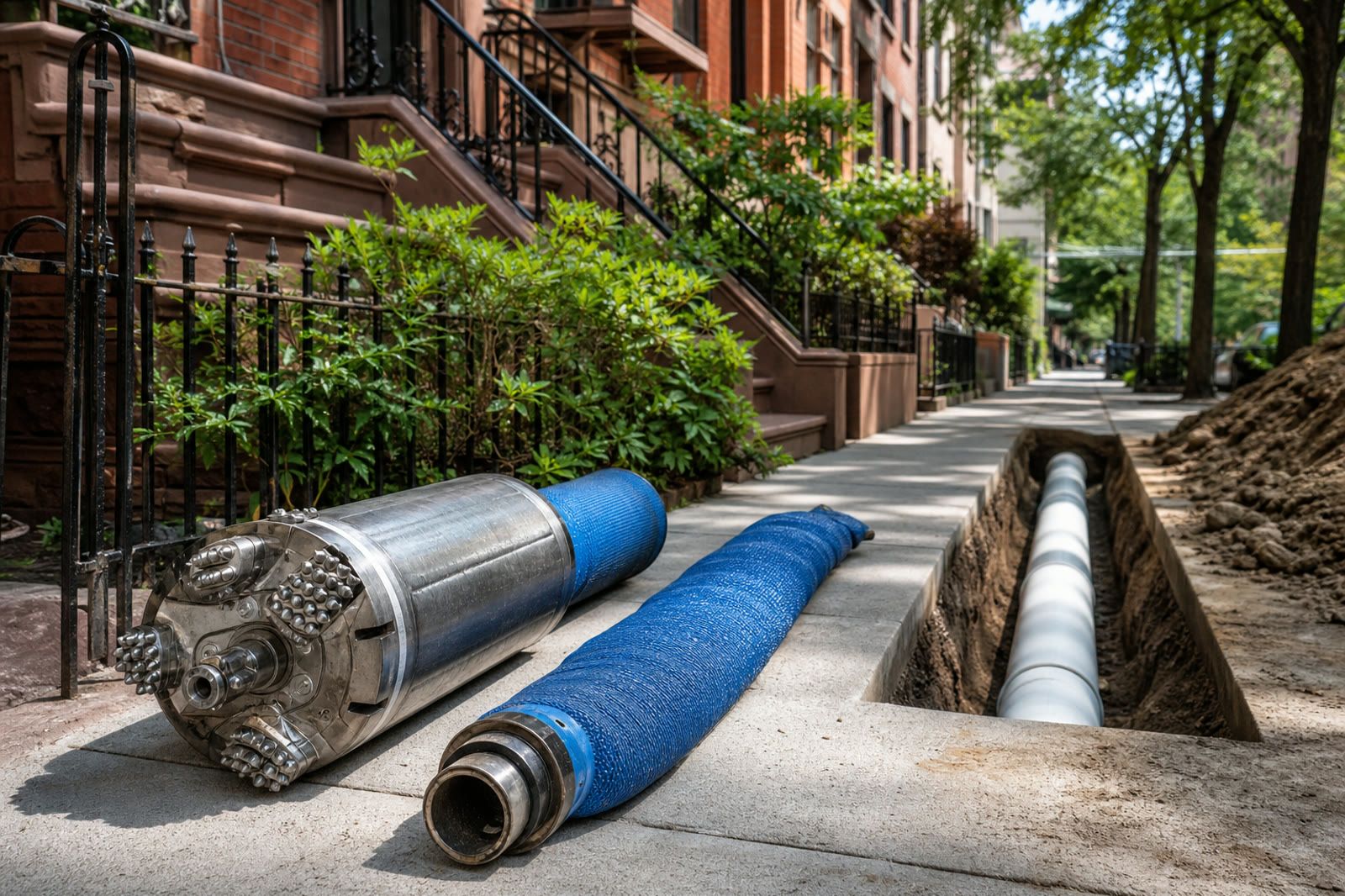
For a true replacement comparison, pipe bursting is the closest trenchless counterpart to open-cut replacement. A bursting head breaks or displaces the old pipe while pulling a new pipe behind it. Entry and receiving pits are still required.
CIPP lining is rehabilitation: a resin-saturated tube is installed and cured inside the host pipe. The EPA’s trenchless fact sheet describes CIPP as using the existing pipe as a host and lists reduced diameter, curing requirements, and installation limitations. A liner may be a valid option in some scopes, but it is not the same proposal as removing or bursting the old pipe and installing a new one.
If a quote says only “trenchless,” ask which method, which material, and whether the result is a new pipe or a liner inside the old one.
The practical comparison
| Decision factor | Pipe bursting | Open excavation |
|---|---|---|
| Surface opening | Entry and exit pits, plus connection access | Trench or targeted excavations along the work |
| Old pipe | Broken outward as new pipe is pulled | Exposed and physically removed or bypassed |
| Grade control | Follows the existing route; cannot casually correct every bad profile | Allows direct bedding and grade correction |
| Collapsed/offset route | May be blocked by severe conditions or obstacles | Can expose and rebuild the failed route |
| Utilities | Must be located; ground displacement is a concern | Utilities still matter but are visible as exposed |
| Restoration | Usually less continuous surface restoration | More excavation and restoration, but direct access |
EPA describes pipe bursting as a method that pulls a new pipe behind an expansion head while the old pipe is forced outward. Its pipe-bursting fact sheet calls for history review, CCTV, access pits, utility awareness, service reconnections, testing, and restoration. That is a construction process, not a magic hose through the cleanout.
When pipe bursting may fit
Pipe bursting can be worth evaluating when:
- the replacement follows a known, continuous route;
- the existing material and surrounding soil are compatible with the equipment;
- severe offsets, encasements, fittings, or other obstructions will not stop the head;
- there is room for properly placed insertion and receiving pits;
- nearby utilities can be located and protected;
- service connections can be identified and reconnected; and
- reducing disturbance across a front yard, sidewalk, or finished interior has real value.
EPA notes that bursting can install a pipe of similar or larger diameter, but also lists limitations: pits are required, percussive action can move the ground, flow must be managed, and the method may not suit every pipe material or condition.
On a Brooklyn brownstone lot, the attraction is obvious. A continuous trench through a finished cellar, front areaway, stoop zone, sidewalk, or planted area can carry a large restoration burden. Reducing that opening can matter. It does not erase street, sidewalk, access, or connection work.
When excavation may be the more controlled answer
Open excavation may fit better when:
- the pipe has collapsed so severely that a bursting route cannot be established;
- grade or a belly must be corrected with new bedding;
- the alignment needs to change;
- a thick repair coupling, concrete encasement, utility conflict, or other obstacle blocks bursting;
- there is no workable pit location;
- several connections need direct reconstruction; or
- exposing the line is the safest way to understand an uncertain condition.
Direct access is disruptive, but it lets the crew see the soil, old pipe, connections, and bedding. A bad grade cannot be wished away by installing a new pipe along the same profile. The restoration line item may be larger, while the underground control may also be greater.
Brownstone constraints to map before choosing
Access and staging
Narrow lots, cellar stairs, occupied units, sidewalk traffic, and limited equipment space affect both methods. A trenchless machine and fused pipe still need a workable setup; excavation needs spoil handling, protection, and restoration.
Existing route and material changes
Pre-war cast iron may transition to clay and then to a newer repair. Camera footage can identify visible transitions, but buried fittings, encasements, and undocumented work may remain unknown. A camera inspection and surface locate reduce uncertainty without pretending to eliminate it.
Street trees and utilities
London planes and sycamores are part of Brooklyn’s streetscape. Roots may share crowded soil with gas, water, electric, telecom, and sewer infrastructure. “Trenchless” does not authorize unreviewed work near a street tree or utility. Required mark-outs, agency rules, and protections still apply.
Permits and restoration
NYC DEP requires a Licensed Master Plumber to file a permit to repair or relay a sewer house connection. DOB explains the house-connection application and inspection process. Work affecting a street or sidewalk can add agency coordination and restoration requirements.
Ask who owns every part of that scope. Brooklyn Sewer Solutions does not publish an unverified license number in this content.
Compare proposals method for method
A useful proposal should state:
- the footage and defect pattern supporting replacement;
- the measured start, end, depth assumptions, and route;
- the exact trenchless or excavation method;
- pit or trench locations and dimensions;
- new pipe material and diameter;
- how grade, connections, utilities, and flow will be handled;
- what surfaces will be opened and restored;
- who files permits and coordinates inspections; and
- which concealed conditions can change the scope.
Use the sewer-line repair page to understand the diagnosis-first process and the pricing page to compare what moves the total. A low excavation number that excludes restoration is not comparable to a trenchless number that includes it.
Frequently asked questions
Is trenchless sewer replacement really no-dig?
No. Pipe bursting generally needs entry and receiving pits, and connections may require additional access. The benefit is less continuous excavation, not zero excavation.
Can pipe bursting fix a sewer belly?
Not reliably just by following the old route. A grade defect may require excavation, new bedding, or a redesigned alignment. Ask how the proposal corrects the profile rather than merely replacing material.
Is a CIPP liner the same as replacement?
No. CIPP forms a liner inside the host pipe. Pipe bursting and open-cut work install replacement pipe. Compare structural design, diameter, defects, connections, and limitations—not just the word “trenchless.”
Which method is cheaper for a Brooklyn brownstone?
There is no honest universal answer. Length, depth, pits, utilities, street work, interior finishes, restoration, and concealed conditions determine the scope. Compare complete proposals.
Replacement decided? Now choose from the route
Brooklyn Sewer Solutions is owner-operated and available 24/7. We show the visible conditions first, then explain which method the route supports. We won’t quote what we can’t show you.