
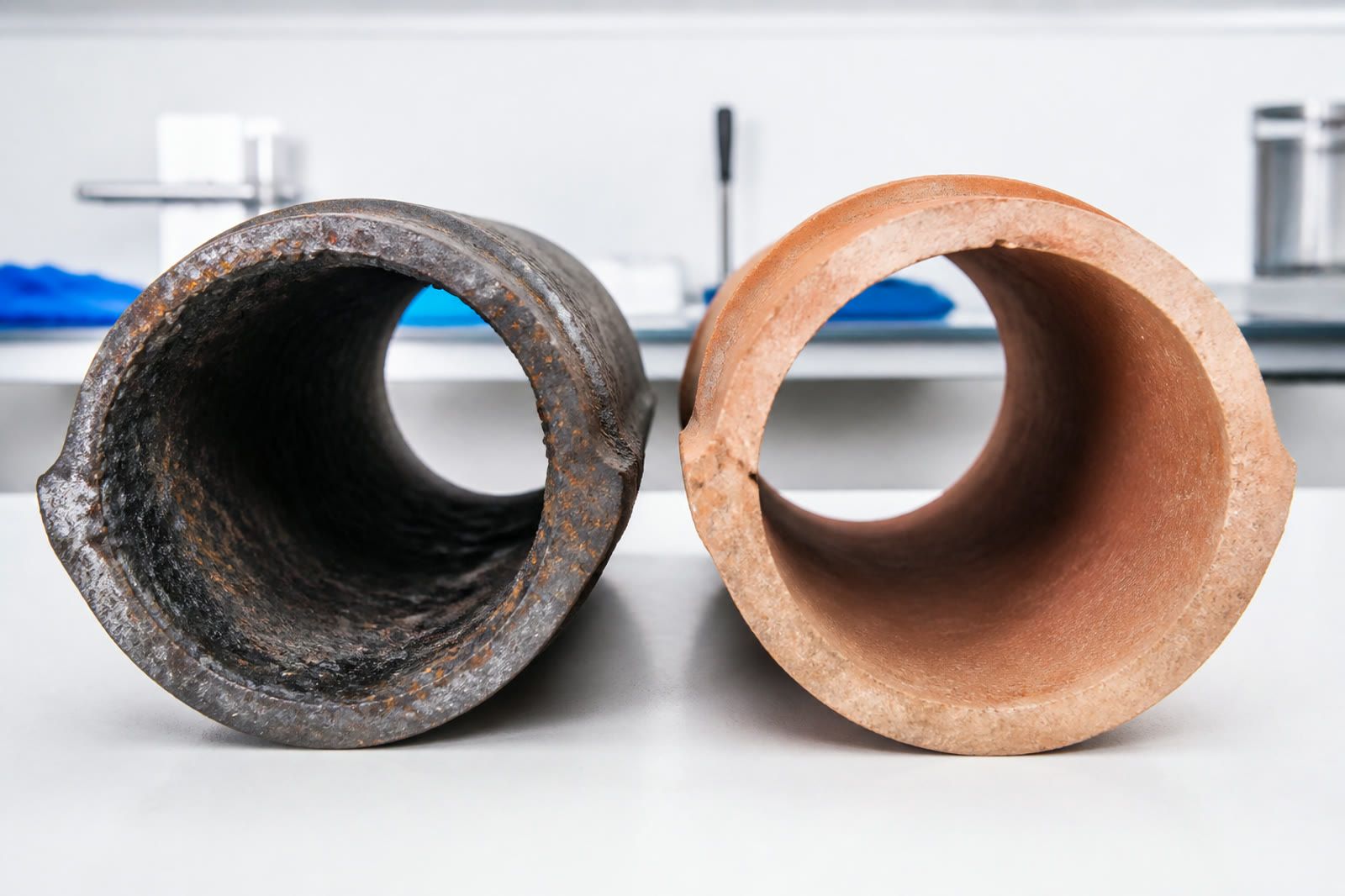
Cast iron vs. clay sewer pipes: what Brooklyn owners need to know
Cast iron and clay fail differently. Older cast iron is vulnerable to internal and external corrosion, rough scale, breaks, and joint leakage. Clay resists corrosion but is brittle, comes in short sections with many joints, and is vulnerable to cracks, offsets, leakage, and root intrusion. Neither material should be condemned by age alone.
In a Brooklyn brownstone, you may have cast iron inside the building, clay outside, and a newer repair section between them. The decision comes from the visible defect and how much pipe is affected—not from one label on a quote.
The short comparison
| Question | Cast iron | Vitrified clay |
|---|---|---|
| Main strength | Rigid, durable, and traditionally used in building drainage | Corrosion-resistant and strong in compression |
| Common aging problems | Corrosion, scale, breaks, joint failure, leakage | Cracks, broken sections, offset or leaking joints, roots |
| Root entry | Through failed joints, cracks, or connections | Often through old or separated joints and cracks |
| Camera appearance | Dark metal, rust-colored deposits, rough or narrowed interior | Lighter segmented pipe with frequent visible joints |
| Automatic verdict | Not “replace all” | Not “replace all” |
The EPA’s rehabilitation white paper lists corrosion and joint failure among typical cast-iron defects. For vitrified clay pipe, it lists roots, cracks, broken pipe, joint misalignment, and leakage. Those are categories to inspect for, not a diagnosis of your lateral.
Cast iron: watch the inside and the outside
Cast iron may be present in a pre-war building’s soil stack, cellar drainage, and part of the run toward the street. Its wall is rigid and substantial, but iron can corrode.
Inside, corrosion products and deposits can create a rough channel that catches paper and waste. The open passage may become smaller even when the pipe has not collapsed. Outside, soil and moisture can contribute to wall loss. Hub-and-spigot or other joints can leak or move, and transitions to a different material can become weak points.
A camera can show scale, standing water, a hole, cracking, an offset, or a material transition. It cannot measure every remaining wall thickness from an ordinary visual pass. When the footage shows a rough but continuous pipe, cleaning may be part of the assessment; when it shows perforation, severe section loss, or repeated failure, repair becomes a structural question. See how we choose between cleaning and sewer-line repair.
Clay: corrosion-resistant, joint-heavy, and brittle
Vitrified clay does not rust. An EPA pipe-material guide describes it as strong and resistant to acids, but also brittle. Because traditional clay pipe came in short lengths, an older lateral may contain many joints. Every joint is another location where old sealing material, soil movement, or installation alignment can matter.
The USDA Forest Service’s review of root intrusion found old clay and concrete systems without rubber-gasketed joints especially prone to roots. Roots do not drill through sound pipe because a London plane or sycamore happens to stand above it; they exploit an opening that already leaks moisture or admits a root tip.
On camera, clay often appears as a series of short, lighter-colored sections. Look at the joints: are they aligned, separated, offset, leaking, or holding roots? Also look for longitudinal or circumferential cracking and broken pieces. One root-filled joint is a different scope from multiple displaced or fractured sections.
Brooklyn laterals can contain both
Building age does not prove pipe material. Renovations, emergency repairs, and utility work can create a mixed line: cast iron leaving the building, clay under the front area, and PVC at a repaired section. A camera may show each transition if the line is accessible and clear enough to inspect.
That mixed history is common enough to make “your brownstone has clay” a weak sales pitch. Our brownstone-backup guide covers the building context, but the pipe still has to identify itself on screen.
The location of the defect matters as much as the material. A failed joint under an accessible cellar slab, beneath a front garden, under a landmarked stoop, or in the street can lead to very different restoration and permitting work.
Which pipe handles roots better?
Sound, watertight joints are the defense. An EPA sewer manual notes that durable, watertight joints are unlikely to admit roots. Properly constructed PVC and fiberglass systems showed resistance in the Forest Service review.
Between old cast iron and old clay, the real comparison is not “metal versus tree.” It is the number and condition of joints, cracks, connections, and transitions. Clay’s numerous older joints often create more opportunities. Cast iron can still admit roots where corrosion, fracture, or joint failure creates an opening.
Clearing roots with hydro-jetting or a suitable cable tool can restore flow when the pipe is safe to clean. It does not seal the entry point.
How a camera changes the decision
A camera inspection can help answer:
- Which materials are visible, and where do they change?
- Is the blockage grease, scale, roots, debris, or a structural failure?
- Is one joint affected or are defects repeated?
- Does water stand in the pipe, suggesting a grade or alignment problem?
- Can the camera reach the City connection, or does an obstruction stop it?
- Where is the defect measured from the access point?
The camera is not magic. Heavy scale, murky water, or a complete blockage can hide the wall. Cleaning may be needed before a full condition pass. We explain that limitation rather than call a partial view a full diagnosis.
Frequently asked questions
How can I tell whether my sewer line is cast iron or clay?
Visible cellar pipe may provide a clue, but it does not prove what runs underground. A camera can identify visible material characteristics and transitions in accessible, cleared portions of the line.
Is clay sewer pipe automatically bad?
No. Vitrified clay resists corrosion and can remain serviceable. The concerns are brittleness, old joints, cracks, alignment, leakage, and roots—not the material name by itself.
Can hydro jetting damage old cast iron or clay?
Cleaning pressure and method must match the pipe’s condition. A severely broken, collapsed, or compromised line may not be a jetting candidate. Inspect first; do not jet blind.
Should every old sewer line be replaced?
No. One isolated defect may support a targeted repair, while repeated structural failures may support rehabilitation or replacement. Our repair-versus-replacement guide lays out that decision.
Want to know what is under your brownstone?
Brooklyn Sewer Solutions is owner-operated and available 24/7. We inspect the accessible line, show the material and defect we can actually see, and scope from that evidence.