
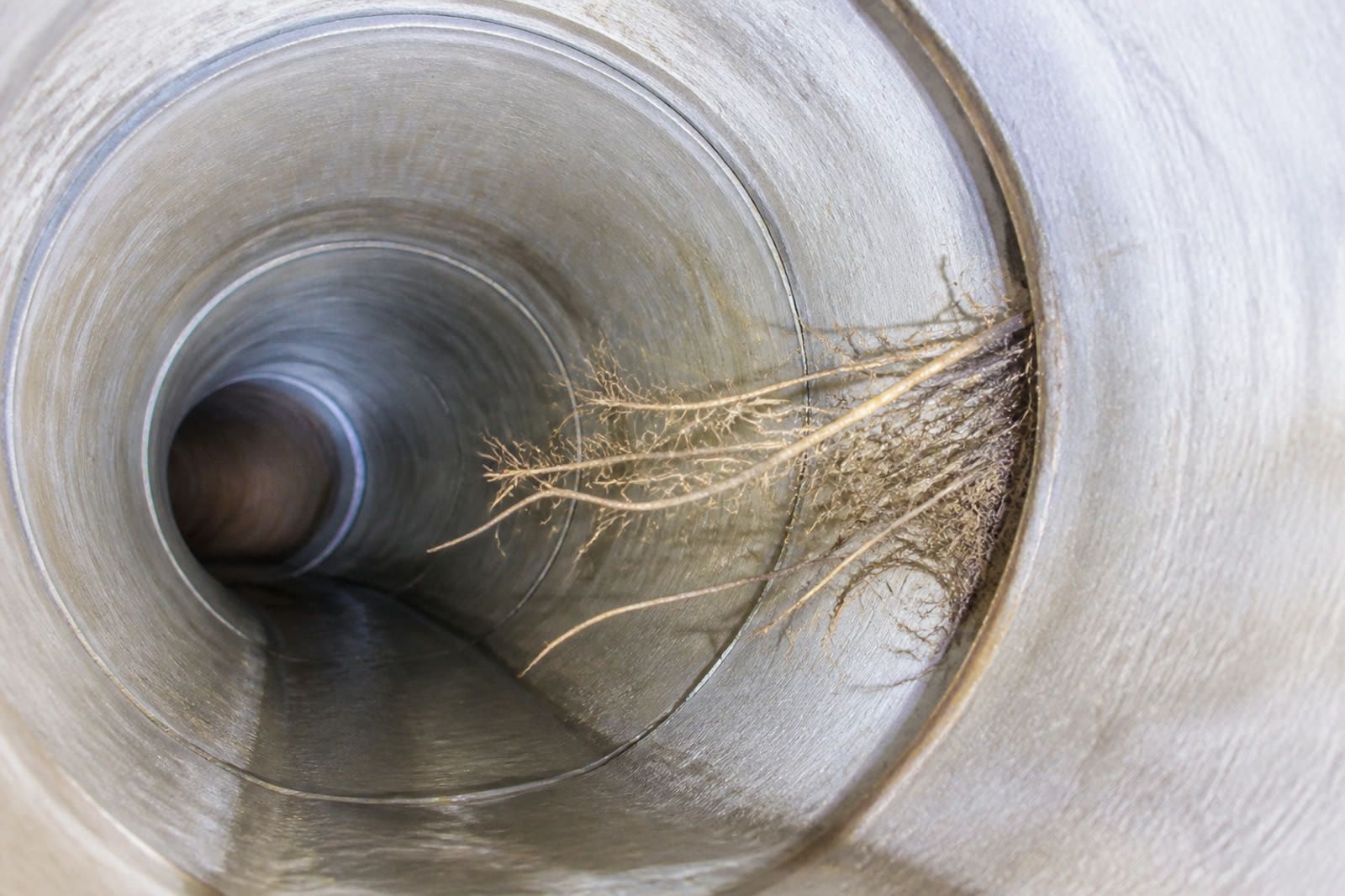
5 signs tree roots are in your Brooklyn sewer line
Roots don’t announce themselves with one big backup. They build up slowly, and every early sign looks minor on its own. Here are the five that matter — and what each one may be telling you.
If your house is on a tree-lined Brooklyn block and has an older clay or cast-iron sewer line, root intrusion is one possibility a camera can reveal. Research summarized by the USDA Forest Service found older clay and concrete sewers without rubber-gasketed joints especially prone to root intrusion. The good news: the problem can show warning signs before it becomes a flooded basement. You just have to know what you’re looking at.
1. The same drain keeps clogging every few months
One clog is life. The same clog, on a schedule, is a pattern — and patterns have causes. When a root mass sits in the line, it acts like a net: it catches paper, grease, and debris until flow stops. You snake it, the opening is restored, and then debris can build up again if the roots and entry point remain. The same Forest Service review describes mechanical root cutting as a temporary control because roots can regrow when the opening in the pipe remains.
If you’ve cleared the same line two or more times in a year, stop paying for the same temporary fix on repeat. A camera inspection shows you exactly what the snake keeps passing through.
2. Multiple fixtures are slow at the same time
A slow bathroom sink is usually a local problem — hair and soap buildup in that fixture’s trap. But when the toilet, the tub, and the basement floor drain all slow down together, the blockage may be downstream of all of them: in the main line. In an older Brooklyn house, roots at a failed joint are one possible cause.
3. Gurgling sounds when other fixtures run
Flush the toilet and hear the tub gurgle? Run the washing machine and hear the floor drain talk back? That can be air moving around a partial blockage. Water is finding a path past something that shouldn’t be there, and displaced air is escaping through another fixture. Gurgling can be an early warning sign worth investigating before the first real backup.
4. A sewer smell in the basement that won’t go away
A partial blockage can let waste sit in the line instead of flowing through. That odor may find its way up through floor drains and old cleanouts. If the basement smell comes back a day or two after every cleaning, the source may be the line rather than the basement itself.
5. A bright green stripe on the lawn or tree pit
A leaking sewer joint can add water and nutrients to the soil above it. In summer, that may show up as a noticeably greener, faster-growing patch along the sewer lateral. Roots can exploit the same leaking joint, although landscaping alone cannot diagnose what is happening underground.
Why older Brooklyn lines can be vulnerable
The tree is only half the story. A root needs an opening: a crack, separated joint, failed connection, or another weak point that lets moisture escape. An EPA collection-system manual notes that durable, watertight joints are unlikely to admit roots. That is why the condition of the line matters more than guessing from the species above it.
Brooklyn has plenty of mature canopy. In the city’s 2005–2006 street-tree census, the NYC Parks Brooklyn report identified London planetree as the borough’s most common street-tree species. London planes, sycamores, oaks, and maples may all be near old laterals, but a tree name cannot tell you whether a pipe is cracked or where roots entered.
Older clay pipe has many short sections and joints; cast iron has different vulnerabilities, including corrosion and joint failure. Mature trees plus a sewer lateral with a cracked, separated, or leaking joint create the opening roots can exploit. We cover the mechanics on our root intrusion page, including how camera evidence guides the choice between clearing the roots and repairing the entry point.
What to do if you’re seeing two or more of these
Don’t guess, and don’t let anyone quote a major repair without showing you the inside of your own pipe. A camera can go in through an accessible cleanout so you can see what is in the line, where the problem appears, and whether the surrounding pipe looks sound. You watch the same screen we do.
If it is roots, there are two honest paths: clear them as a temporary measure, often with hydro-jetting, or repair the entry point that let them in. Which one makes sense depends on what the camera shows, the condition of the pipe, and your plans for the building. We’ll lay out both with the footage in front of you.
Frequently asked questions
How fast do tree roots grow back in a sewer line?
There is no honest universal interval. Regrowth depends on the opening, tree, pipe condition, and how completely the roots were cleared. The Forest Service review reports that some utilities repeat mechanical removal annually, but that is maintenance history—not a countdown for your house. Clearing restores flow but does not repair the place where roots entered, so the problem can return until that defect is fixed.
Can roots get into PVC sewer pipes?
Roots need an opening. Properly constructed PVC and fiberglass systems were resistant to intrusion in the Forest Service research, while an EPA assessment guide lists deflection, alignment, and connection problems among PVC’s material-specific defects. In plain English: sound modern joints are less vulnerable than old separated clay joints, but a damaged or poorly connected line can still have an entry point. A camera inspection is the practical way to confirm the material and the defect.
Should I cut down the tree?
Usually, the first step is to diagnose and repair the pipe defect rather than assume the tree must go. Do not remove or damage a street tree without checking New York City requirements. The camera evidence tells you what happened inside the line; an arborist or NYC Parks can advise on the tree itself.
Related
- Root Intrusion in Brooklyn — the full breakdown
- Video Camera Inspection — how we confirm it
- Hydro-Jetting — one option for clearing roots
Seeing two or more of these signs?
A camera inspection ends the guessing. Brooklyn Sewer Solutions is available 24/7 and shows you what is in the line before quoting the next step.