
Sewer snake vs. hydro jet: which one actually works?
One opens a path through the clog. The other uses high-pressure water to scour buildup from the pipe. Both have a right time and a wrong time — and anyone who always recommends the more involved option isn’t being straight with you.
Short version: a snake may be the right call for a soft, simple, first-time clog. A hydro jet may be the right call for grease, scale, roots, and recurring buildup. The honest answer for your line depends on what is actually in it — which is why Brooklyn Sewer Solutions uses a camera before recommending either.
What a snake actually does
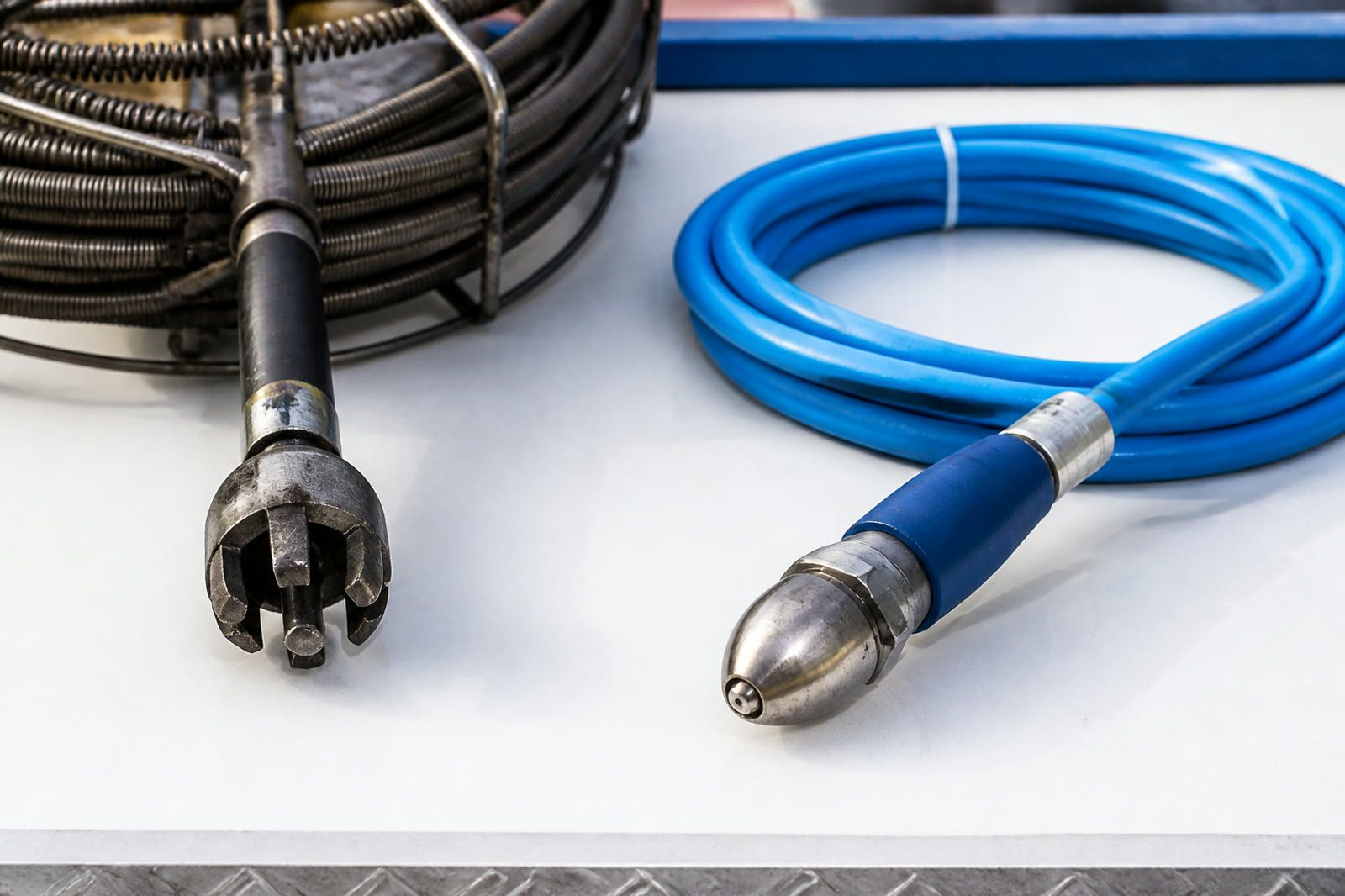
A drain snake, or cable machine, uses a flexible steel cable with a cutting or grabbing head. The cable is fed into the line, and the head bores through a blockage or catches material that can be pulled back out. The tool on the end matters: RIDGID’s cutter guide lists separate heads for grease, scale, roots, rags, and exploratory work. A cable can be effective on an isolated obstruction and is often the simplest way to restore flow.
Here’s the part most companies don’t say out loud: a snake opens a path; it does not necessarily clean the whole pipe wall. If the clog is a wad of paper or another isolated obstruction, opening that path may be the whole fix. But if the pipe walls are coated in grease or scale, or roots remain at a failed joint, material left behind can catch new debris and the clog can return.
What a hydro jet actually does
A hydro jet sends high-pressure water through the line using a hose and specialized nozzle. Professional sewer jetters are not one fixed specification: current manufacturer examples include the 3,000 PSI RIDGID KJ-3100 and 4,000 PSI Spartan Warrior. Flow rate, nozzle, hose, line diameter, and pipe condition matter alongside pressure. Those examples describe available equipment, not the machine on a particular Brooklyn Sewer Solutions job.
Rear-facing jets help pull the hose forward and move loosened material back toward the access point; nozzle designs may also direct water forward or outward for the obstruction and pipe wall. Manufacturer specifications describe jetters as tools for grease, sludge, soap, sediment, and other buildup. Compared with a cable and cutter, the working principle is different: water is used to break up buildup, scrub more of the circumference, and flush debris rather than simply bore a route through it.
That can make it a better fit for recurring buildup. It still does not repair a crack, separated joint, collapsed section, or other structural defect. If roots entered through a failed joint, clearing them restores flow; repairing the entry point is what addresses the cause. An EPA sewer-maintenance manual makes the same distinction for augering: it can relieve a root blockage while root mass remains and regrows at the defect.
When the snake may be the right call
- First-time clogs with no history of trouble on that line
- Soft or isolated blockages such as paper or a known object
- Fixture-level problems affecting one sink or tub rather than the main line
- An urgent blockage where restoring flow is the immediate priority
- A compromised pipe where high-pressure cleaning may not be appropriate
When the hydro jet may be the right call
- Recurring clogs on the same line
- Grease and sludge buildup coating the pipe wall
- Root intrusion where more complete clearing is needed; see our root intrusion breakdown
- Scale buildup in old cast iron that has narrowed the open channel
- Cleaning after an initial camera assessment when the pipe is sound enough for jetting
The honest cost comparison
The price of either service depends on access, line length, the obstruction, and the condition of the pipe. Jetting is usually the more involved visit, but the lower price is not the better value if the same buildup keeps returning.
The comparison that matters is the cost of the work that fits the evidence. If a snake will fully solve an isolated clog, more service is unnecessary. If footage shows buildup across the pipe wall, paying repeatedly to open a narrow path may not make sense. Our pricing page explains what changes the number. We won’t quote what we can’t show you.
How we decide on your job
Camera first. The footage shows what the blockage is, what the pipe walls look like, and whether the line appears sound enough to jet. You watch the same screen we do. If a snake fits the problem, we say so. If the footage shows grease-coated walls, scale, or a root mass, we’ll show you why a more thorough cleaning may fit better. You decide with the evidence in front of you. That is the whole system — more on it at our camera inspection page.
Frequently asked questions
Is hydro-jetting safe for old Brooklyn pipes?
It depends on the pipe’s condition, not just its age. A line with major cracks, separated joints, or a collapsed section may not be a candidate for high-pressure cleaning. That is why the camera comes first. No jetting blind.
Why does my clog keep coming back after snaking?
A snake may open the blockage without removing all grease, scale, roots, or another underlying defect. Cutter selection and passes affect how much material is removed, so “a snake only makes a hole” is too absolute. The useful point is that restored flow does not prove the pipe wall is clean or the defect is repaired. A recurring clog is a reason to inspect the line and identify the cause rather than repeat the same service automatically.
Which one costs more?
Hydro-jetting is generally a more involved service than snaking, but the actual price depends on the job. The useful comparison is not the name of the tool; it is what the camera shows, what each option will accomplish, and whether the underlying pipe needs repair.
Related
- Hydro-Jetting — what it clears and how it works
- Drain cleaning — match the method to the blockage
- Video Camera Inspection — how we pick the right tool
Cleared the same clog twice already?
Stop paying to guess. Camera in, see what is really there, and pick the service that fits the condition of the line.
Call (718) 517-0800 or request a callback.